


Prediction market traders have generated more than $197 million in volume on the U.S. midterms, even as more Americans say betting on election results should be illegal than legal.
- NBC News analyzed 1,408 open midterm markets across Kalshi and Polymarket.
- Nearly half of the volume recorded as of July 1 was tied to gubernatorial races, per the report.
As of press time, the leading outcome on Kalshi is Democrats winning control of both the Senate and House, which traders give a 46% probability.
A Republican Senate and Democratic House followed at 38%.
- Kalshi put the probability of Republicans keeping both chambers at 18%, while Democrats taking the Senate and Republicans retaining the House stood at just 1.9%.
Political betting had already reached a much larger scale during the 2024 presidential election.
By Election Day, users had traded $3.2 billion on Polymarket's market covering the race between Donald Trump and Kamala Harris. Most of the money was placed on Trump, who went on to win the election.
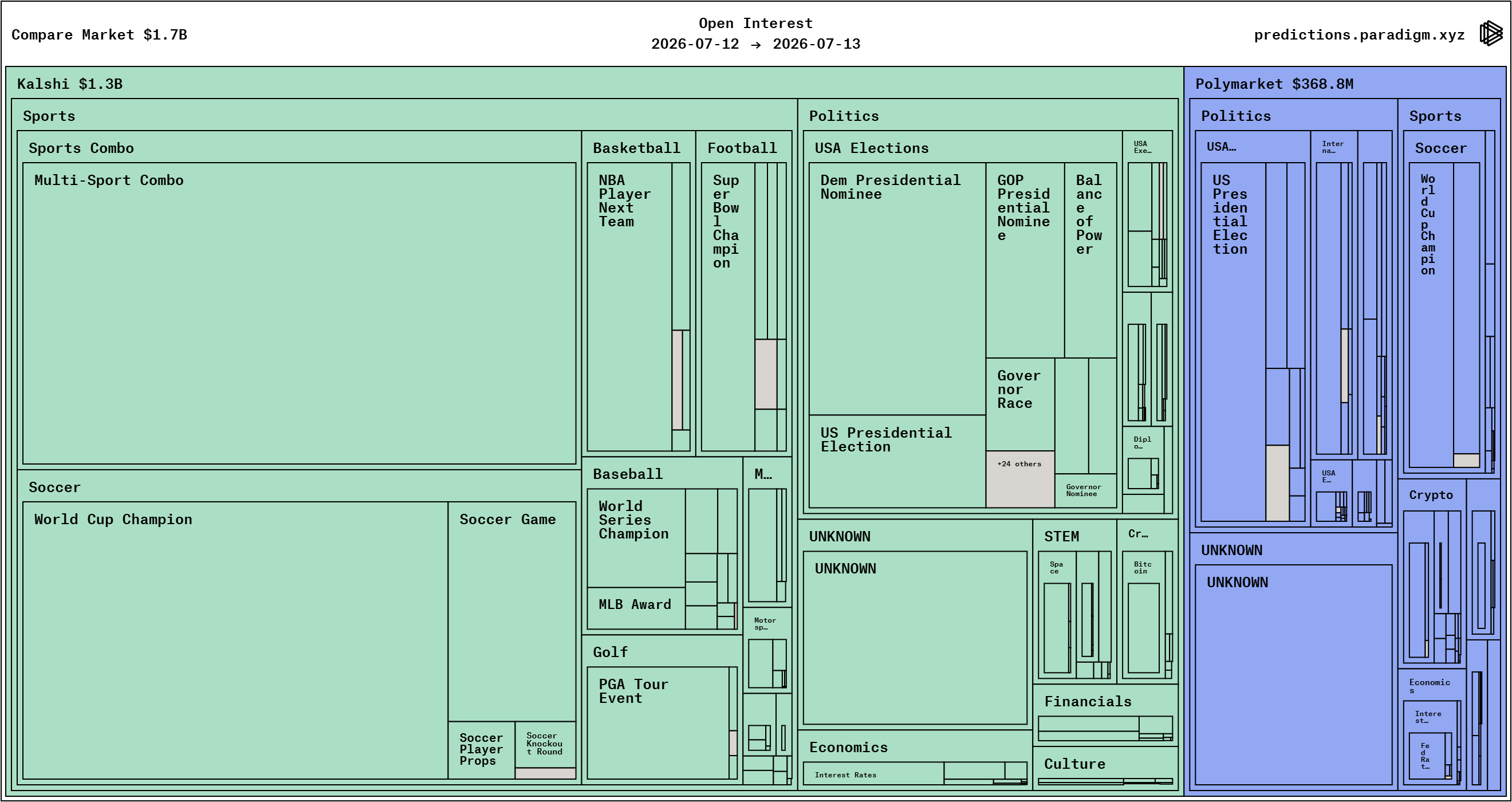
Kalshi vs Polymarket in terms of open interest. Source: Paradigm
- Data from Paradigm's prediction market monitor shows that politics remains Polymarket's largest category by open interest, with more than $155 million, or about 42% of the platform's $368.8 million total.
- Politics is larger in absolute terms on Kalshi, with about $264 million in open interest, but it's nowhere near the platform's biggest category. Sports lead with roughly $908 million as betting surges during the FIFA World Cup.
Despite the growing volume, election betting has yet to win broad public support. A Politico poll conducted by Public First from May 17 to 19 found that 44% of respondents thought prediction markets covering election outcomes should be illegal.
And 30% said they should be legal, while about 25% were unsure.