


Polymarket's five-minute Bitcoin markets may have allowed traders to do more than predict the cryptocurrency's next move. They could also try to create it.
- A working paper by David Dai and Ruizhe Jia of Stanford University and Shihao Yu of Singapore Management University found signs that traders took positions on Polymarket and then briefly pushed Bitcoin's spot price in the same direction during the final seconds before settlement.
The researchers examined roughly 16,000 contracts over about two months after the five-minute product began trading on Feb. 12.
- Each contract pays $1 if Bitcoin finishes the five-minute window above its opening price and nothing if it finishes below.
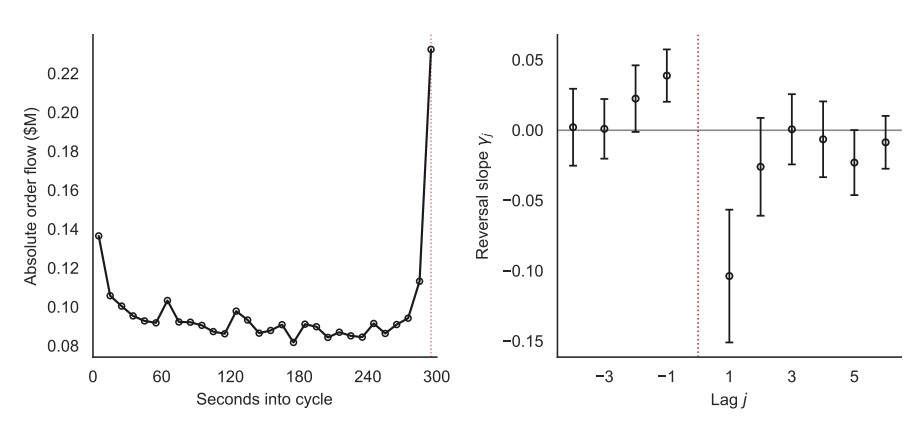
Charts showing the footprint of settlement manipulation. Source: Arxiv.org
To look for possible price manipulation, the researchers studied trading on Binance, the world's largest crypto exchange and a key venue for Bitcoin price discovery.
Polymarket doesn't settle the bets directly from Binance, instead using a Chainlink oracle that combines prices from several exchanges.
- But Binance's price pointed to the same winning outcome as Polymarket about 85% of the time, making its last-second trading activity a useful indicator of whether someone was briefly moving Bitcoin enough to affect the result, the study found.
The final 10 seconds
After Polymarket launched the five-minute bets, Bitcoin trading on Binance repeatedly spiked during the final 10 seconds before settlement. The price often moved in one direction just long enough to decide the bet, then reversed soon afterward, the study found.
- When the outcome was still close, the final-second burst of buying or selling was about 3.9 times larger than during other settlement windows.
The researchers flagged the 10% of windows with the most unusual late trading as the most likely to involve manipulation. In those periods, even bets that Polymarket priced as 90% to 100% certain were overturned 34% of the time, compared with just 1% during normal windows.
David Dai, Ruizhe Jia and Shihao Yu
The study identified more than 820 Polymarket wallets that made a combined $8.2 million during the flagged periods, while accounts classified as retail absorbed 93% of the losses.
However, the analysis doesn't prove that those wallets placed the corresponding Binance trades or establish their intent directly.