



A buried table in the Ontario Securities Commission's 56-page survey shows that 15% of Canadians who used centralized crypto platforms reported losing money to scams, fraud or hacking, The Coinformer's review of the regulator's data found.
Of 424 users of centralized platforms, exchange-like services through which customers buy and sell tokens, 10% reported scam or fraud losses and 9% cited hacking.
Those answers overlapped, producing a net loss rate of 15%. Among the 64 respondents who reported either kind of loss, 31% put it at C$60,000 or more, while 17% lost between C$10,000 and C$60,000 and 51% lost up to C$10,000, according to the survey.
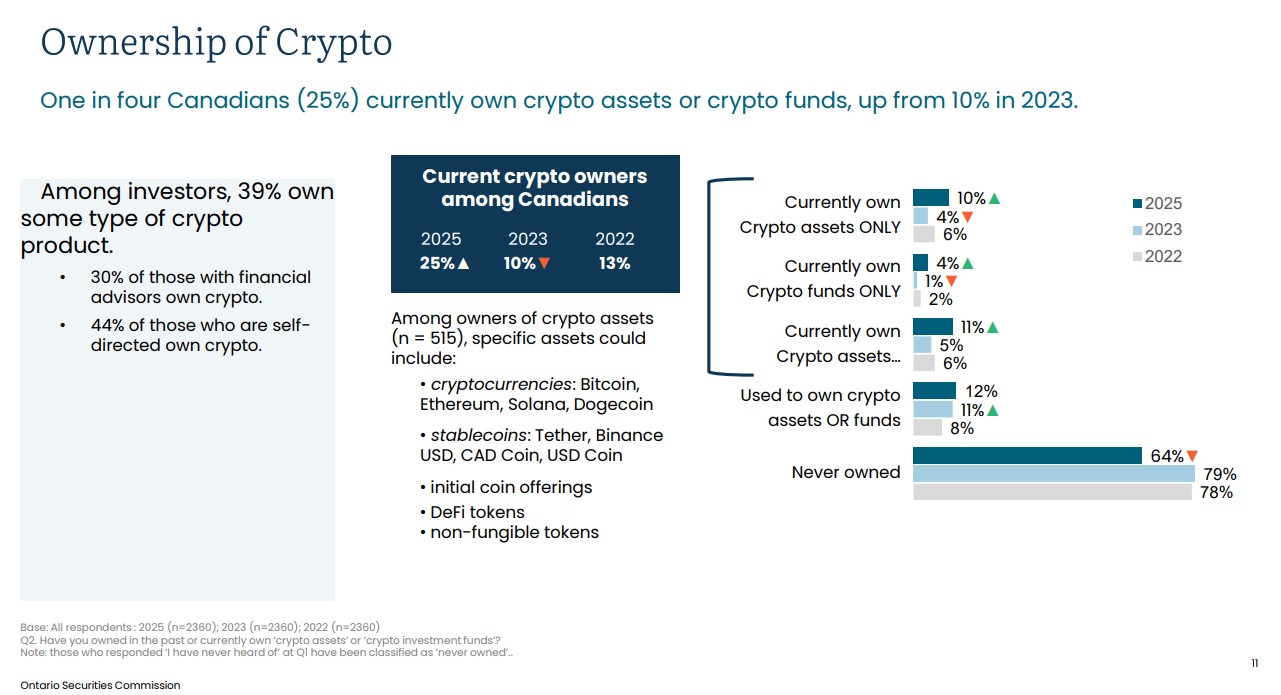
Ownership of crypto in Canada. Source: OSC
The OSC's July 28 release instead led with adoption. Current ownership of crypto reached 25%, compared with 10% in 2023 and 13% in 2022, while accurate awareness rose to 59% from 54%.
"Crypto markets continue to evolve, and Canadians are participating in them more than ever before," said Naizam Kanji, an executive vice president at the OSC, Ontario's capital-markets regulator.
Protection knowledge lagged
However, just 38% of respondents knew that crypto savings accounts are not insured by the Canada Deposit Insurance Corporation, the federal bank-deposit insurer, down from 42% in 2023.
- Even among crypto owners, only 49% answered correctly.
Meanwhile, half of centralized-platform users said they checked whether a platform was registered with their provincial securities regulator, up from 38%.
Registration subjects a platform to regulatory requirements, but it doesn't insure the tokens. The Canadian Investment Regulatory Organization, the national self-regulatory body for investment dealers, says crypto is covered by neither investor-protection funds nor deposit insurance.
Risk appetite was also spreading through traditional advice. Approximately 39% of investors with financial advisers said an adviser had recommended buying crypto directly, up from 19% in 2023.