



Crypto exchange operator Bullish is putting another $100 million behind the AI infrastructure boom, but one of the claims accompanying the deal appears to be considerably bigger than the investment itself.
- Bullish said in a Friday press release that it had provided USD.AI, an on-chain lending platform developed by Permian Labs, with a $100 million stablecoin-based facility that will be used to finance GPUs that power AI training.
- In announcing the deal, Bullish described AI infrastructure financing as one of the largest sectors in private credit, saying its scale now "eclipses legacy debt markets such as auto loans and home equity lines of credit."
But publicly available numbers tell a much less straightforward story.
Auto debt is still measured in trillions
U.S. consumers owed $1.71 trillion in auto loans at the end of June, according to the Federal Reserve Bank of New York's Aug. 11 household debt report. Outstanding home equity lines of credit, or just HELOCs, totaled another $459 billion.
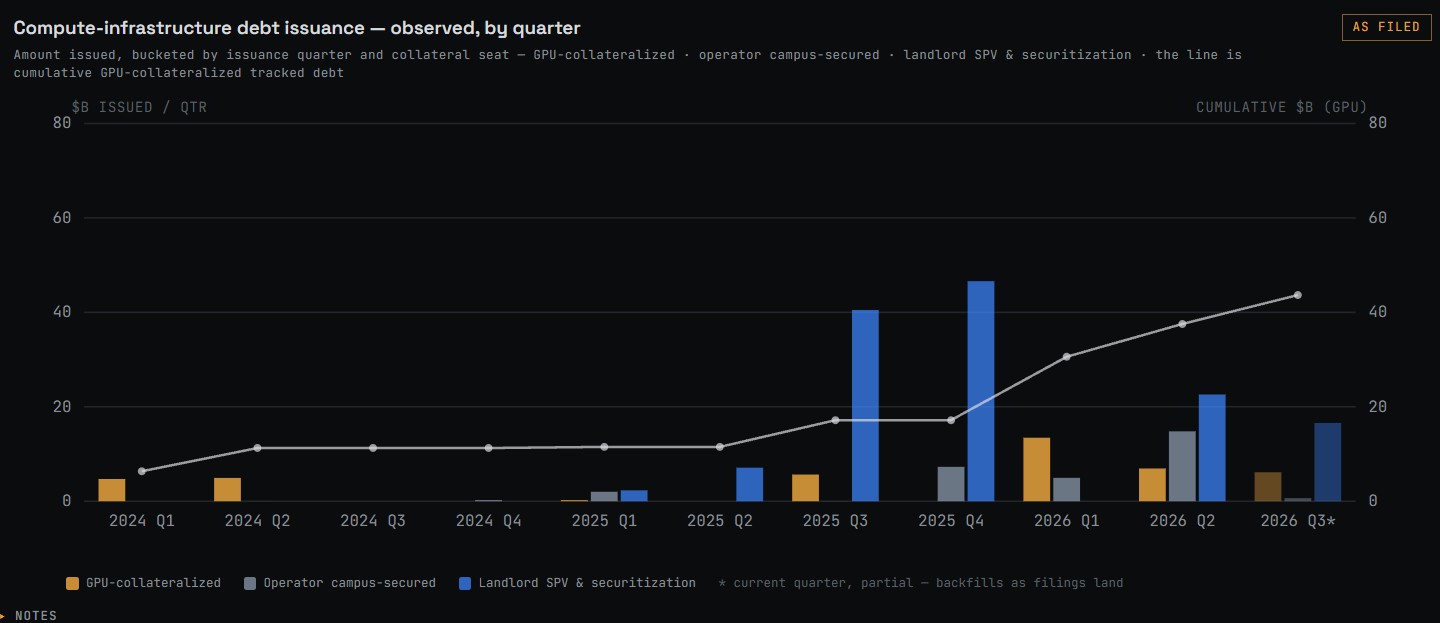
Compute-infrastructure debt issuance. Source: CCIR
- By comparison, one filing-based tracker of compute credit counted roughly $44 billion of debt directly secured by GPUs across 29 financings as of Aug. 27.
- An earlier 2026 estimate from Syz Group put the broader GPU-financing market at roughly $20 billion to $34 billion.
- Even the much broader data-center financing market doesn't clearly support the comparison.
Real-estate firm JLL estimates that the global data-center buildout will require about $870 billion in new debt financing between 2026 and 2030, alongside as much as $3 trillion in total infrastructure investment.
That projected five-year borrowing need is almost twice today's U.S. HELOC balance, but still only about half the size of outstanding U.S. auto debt.
JLL is forecasting future global borrowing across entire data centers, including real estate and infrastructure, while the New York Fed measures existing U.S. consumer balances at a point in time.
Bullish doesn't explain the comparison
Bullish's announcement doesn't give a source for its claim or specify what it counts as AI infrastructure financing, whether the comparison is global or U.S.-only or whether "scale" refers to outstanding debt, expected financing demand, transaction volume or committed capital.
That leaves open the possibility that Bullish is using a much broader measure of projected AI capital needs rather than existing GPU-backed loans.
CoreWeave alone closed an $8.5 billion GPU-backed facility in March and another $3.1 billion facility in May, while other AI infrastructure companies have increasingly used GPUs and contracted compute revenue as collateral.
But based on currently disclosed debt, saying the sector has already eclipsed the auto-loan market appears difficult to square with public figures.
Bullish makes a bigger bet on GPU credit
Bullish, which owns CoinDesk and offers crypto trading services, previously invested $4 million in the protocol in September 2025, when it said USD.AI had already attracted $250 million in private-beta deposits.
The platform lends against GPU hardware and uses on-chain structures to give investors exposure to the resulting credit.
Under the new agreement, Bullish also plans to list USD.AI's yield-bearing sUSDai token across multiple trading pairs and provide dedicated market-making support, potentially creating a secondary market around GPU-backed debt.