

In January, social media started filling up with short clips of young people apparently getting rich fast by placing winning bets on Polymarket, a prediction market platform primarily backed by the Intercontinental Exchange, the parent company of the New York Stock Exchange.
But a new investigation by The Wall Street Journal, based on an analysis of more than 1,100 Polymarket-related videos, instructional materials and interviews with influencers who said they had worked with the company, found that many of those clips were fake.
Per the report, Polymarket paid dozens of mostly college-age influencers to film fake bets and fake wins on dummy versions of its website, while the videos were made to look like ordinary user posts.
The Coinformer briefly retells the WSJ's key findings below.
Fake wins, real markets
One example was George Makihara, a college student whose videos showed him appearing to place 145 Polymarket bets worth almost $410,000 between January and mid-May.
In one January clip, he appeared to win $100,000 on a bet that U.S. President Donald Trump would say "McDonald's" that month.
The McDonald's market did exist, but public data showed more than 50 real accounts bought the same bet, and all of them lost.
Read also: US watchdog sidelined staff who questioned Trump-linked crypto firms: report
Typosquatting
WSJ also found Polymarket built near-perfect copies of its website and told influencers to use those dummy sites for simulated trades.
Some clips briefly showed URLs that appeared to be Polymarket test environments, while one lookalike site, "poiymarket," went offline shortly after WSJ contacted Polymarket.
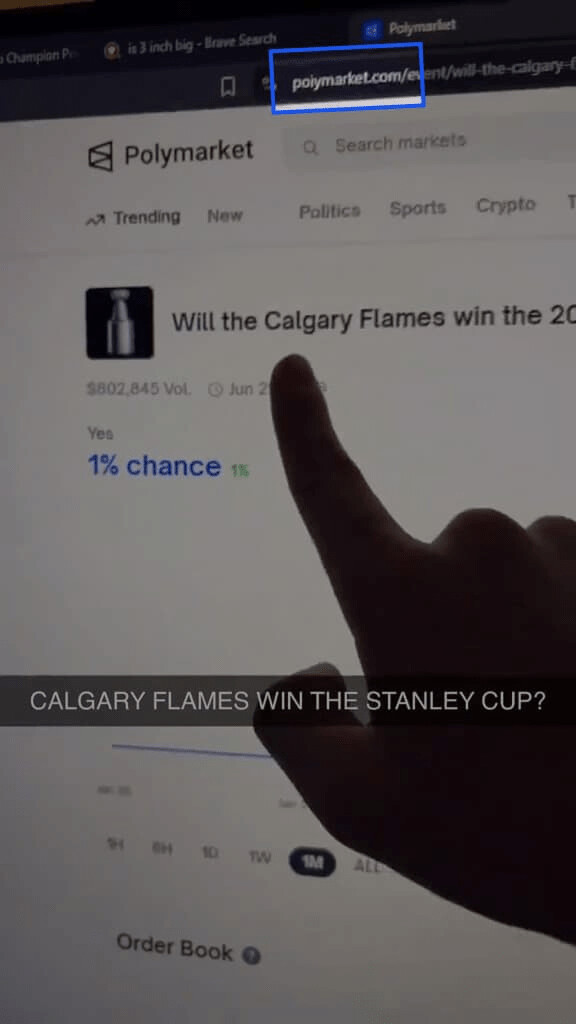
An example of a fake trade on "Poiymarket." Source: WSJ
Influencers told WSJ that Polymarket gave them talking points, reviewed finished videos and asked for reshoots when clips were not engaging enough or looked too fake.
- They said pay often reached $2,000 to $3,000 a month.
Influencers also said they were told not to disclose that Polymarket was paying them. Some added "@polymarket partner" to their bios only after WSJ began asking about the campaign.
Targeting Americans
The investigation also found that Polymarket worked with marketing firm Virality to push the clips through repost accounts. The campaign generated more than 140 million views, according to Tubular data cited by WSJ.
Polymarket's main platform has been blocked from serving U.S. users since a 2022 CFTC settlement. Still, WSJ found that clippers were paid only if at least 60% of their audience was in the U.S.
A spokesperson for Polymarket told WSJ it was "committed to maintaining accurate, fair, and transparent markets. We are part of a rapidly growing industry and are constantly evaluating ways to improve how we're engaging and earning the trust of our audience."
More context: CME CEO steps down after clashing with crypto perps and Polymarket