



Korean retail traders have long had a reputation in crypto for showing up near market tops, but new research from 4Pillars suggests that pattern may be misunderstood.
- In a research blog post published on Aug. 25, the crypto research firm analyzed 286 Korean-won markets on Upbit since 2017 and extended the dataset back to 2013 using Bithumb and Korbit.
- They found that Korea's biggest speculative bursts have historically lined up more closely with altcoin peaks than with Bitcoin tops.
- The researchers also compared Korean activity with Binance, Coinbase, Bitstamp and Bitfinex, looking at trading volumes and the so-called Kimchi premium, the difference between crypto prices in South Korea and on global exchanges.
4Pillars researcher Ponyo.
Mania came after Bitcoin topped
Rather than arriving only at the very end of a Bitcoin bull market, Korean retail activity appears to have picked up earlier, around the point when traders began moving into altcoins, the researcher says.
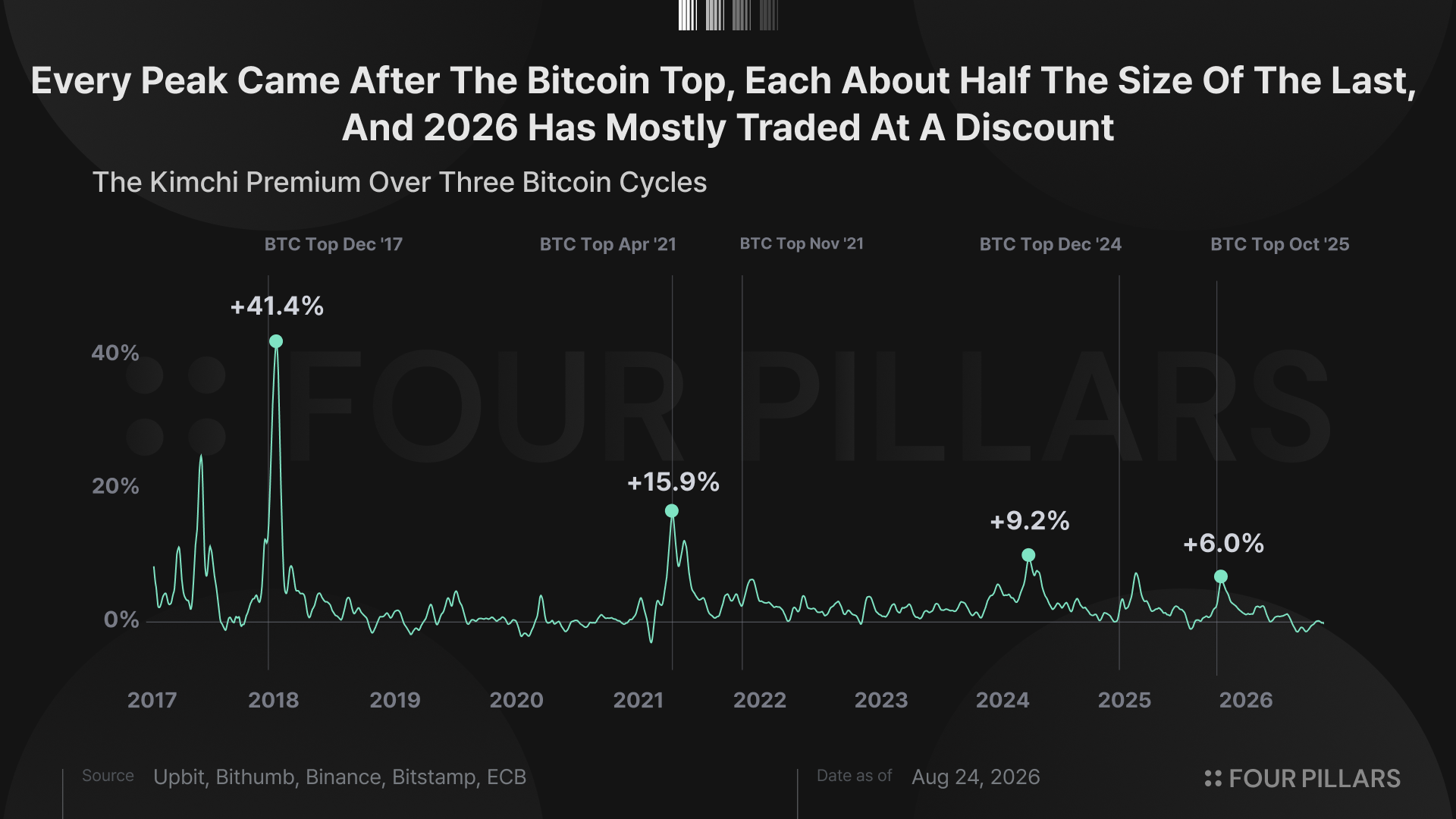
The Kimchi premium over three Bitcoin cycles. Source: 4Pillars
But the most intense periods of Korean speculation tended to come later, after Bitcoin itself had already peaked.
- For instance, that pattern was clearly visible in 2017, when Bitcoin reached its cycle high on Dec. 16, but the Kimchi premium didn't peak until Jan. 8, 2018, when it reached about 58.6%, according to 4Pillars.
- The move came 23 days after Bitcoin's top and roughly coincided with the broader altcoin market reaching its own high.
Upbit averaged about $3.9 billion in daily volume in January 2018, compared with $2.8 billion in December, while Bitcoin made up only around one-fifth of trading as XRP, ADA and SNT dominated activity.
Then, the sequence appeared once again in 2021, when BTC reached a major high on April 13, yet 4Pillars found that Upbit's 11 largest trading days on record all came during the following six weeks.
The exchange's biggest day arrived on April 16, when it processed roughly $35 billion in volume, including about $15.3 billion in DOGE alone.
While that doesn't necessarily mean Korean traders caused the subsequent market tops, the findings suggest extreme Korean trading activity may be a better indicator of where speculative appetite sits within a market cycle.
Korea's influence is fading
The effect also appears to have weakened substantially with each cycle as data from 4Pillars shows that Korea's peak share of Bitcoin trading volume relative to four major global exchanges fell from 44.7% in December 2017 to 11.8% in April 2021, 9.9% in December 2024 and 6.6% around the October 2025 Bitcoin high. Peak Kimchi premiums compressed alongside it, Ponyo writes.
The Kimchi premium stood at just 0.8% on the day, while Upbit was processing roughly $2 billion to $3 billion a day, far below the frenzy seen in 2021.
4Pillars suggested one possible explanation is that the marginal buyer at Bitcoin tops has changed, with U.S. spot Bitcoin ETFs and corporate treasury vehicles taking a larger role.
No Kimchi mania in the latest rally
The latest Bitcoin rally looks different from previous Korean speculative waves as well.
- Bitcoin rose more than 23% over the seven sessions through Aug. 23, according to 4Pillars, yet the Kimchi premium remained negative and at one point deepened to around a 1.4% discount.
- Korean traders were still active, but much of that activity was concentrated elsewhere.
- XRP's share of Upbit trading rose from 8.2% in July to 23.8% during the move, while TRUMP also gained a much larger share of activity.
- USDT, meanwhile, became Upbit's largest market by turnover on Aug. 19.
- Bitcoin itself remained at roughly 8% of Upbit trading.
As Ponyo argues, that is almost the opposite of what preceded previous periods of Korean mania, when the Kimchi premium turned positive and remained there while trading volumes built over several weeks.
4Pillars also found that the Kimchi premium has been negative on 134 of 236 days so far in 2026, while Upbit's volume relative to Binance fell from roughly 10% over the trailing year to 5.4% over the past three months.