



Hyperliquid is finding an unexpected audience in Japan as stock traders use its perpetual futures alongside equity portfolios to manage market risk.
- Japanese traders are increasingly using on-chain derivatives alongside traditional investments, including positions on Hyperliquid to hedge directional and macro exposure in their stock portfolios, according to a new Chainalysis report published on Monday, Oct. 5.
- The practice offers a different picture of Japan's growing decentralized finance market, where crypto trading is starting to overlap with habits developed in one of the world's largest traditional investment markets.
"The most visible activity is in perps," Taishi Sato, CEO of DeFimans, an SBI Group company, told Chainalysis.
Sato said traders are using venues such as Hyperliquid alongside equity portfolios to manage directional and macro exposure rather than treating them purely as crypto-native trading platforms.
Perps meet stock portfolios
Chainalysis didn't quantify how many Japanese investors are following that strategy or how much Hyperliquid volume it represents.
Its broader data, however, shows Japanese retail investors moving increasingly toward decentralized trading.
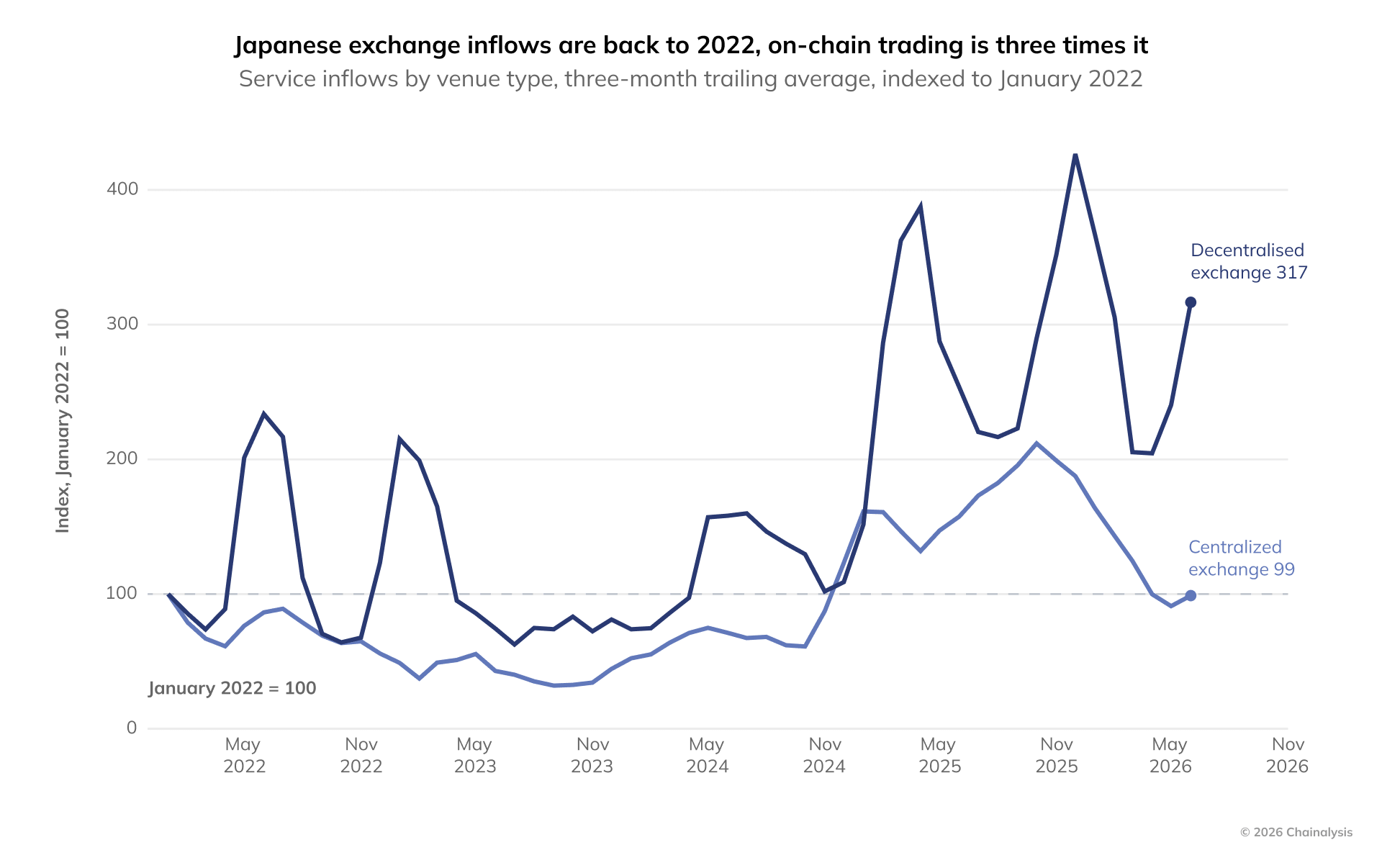
Japanese crypto exchange inflows. Source: Chainalysis
- Roughly one in four users who withdraw crypto from exchanges operating in Japan later deposit funds into DeFi protocols, according to the report.
- Decentralized exchanges captured nearly 35% of Japan's crypto service activity during the period studied, the highest share among East Asian markets with mature centralized exchange industries.
Japan's DEX activity has risen more than 200% since 2022 while centralized exchange activity has remained roughly flat, Chainalysis found. Most of those decentralized trades aren't large institutional transactions either.
The shift gives Hyperliquid a role that looks increasingly familiar to traditional markets. Instead of using the platform only to speculate on crypto prices, some Japanese traders are apparently adding on-chain positions around existing stock exposure.
- Japan has a long history of active foreign-exchange trading, something Sato said may help explain the crossover.
- Traders already familiar with leverage, hedging and macro bets can bring much of the same playbook to perpetual futures.
Retail moves on-chain
That behavior also stands out against the usual description of Japan's crypto industry.
Banks, brokers and financial groups have been among the most visible companies experimenting with digital assets in the country. Yet Chainalysis found that retail traders still leave a much larger on-chain footprint than that institutional narrative might suggest.
Japan handled roughly $228.3 billion in crypto activity during the report's July 2025 to June 2026 period, making it East Asia's second-largest measured crypto economy behind South Korea.
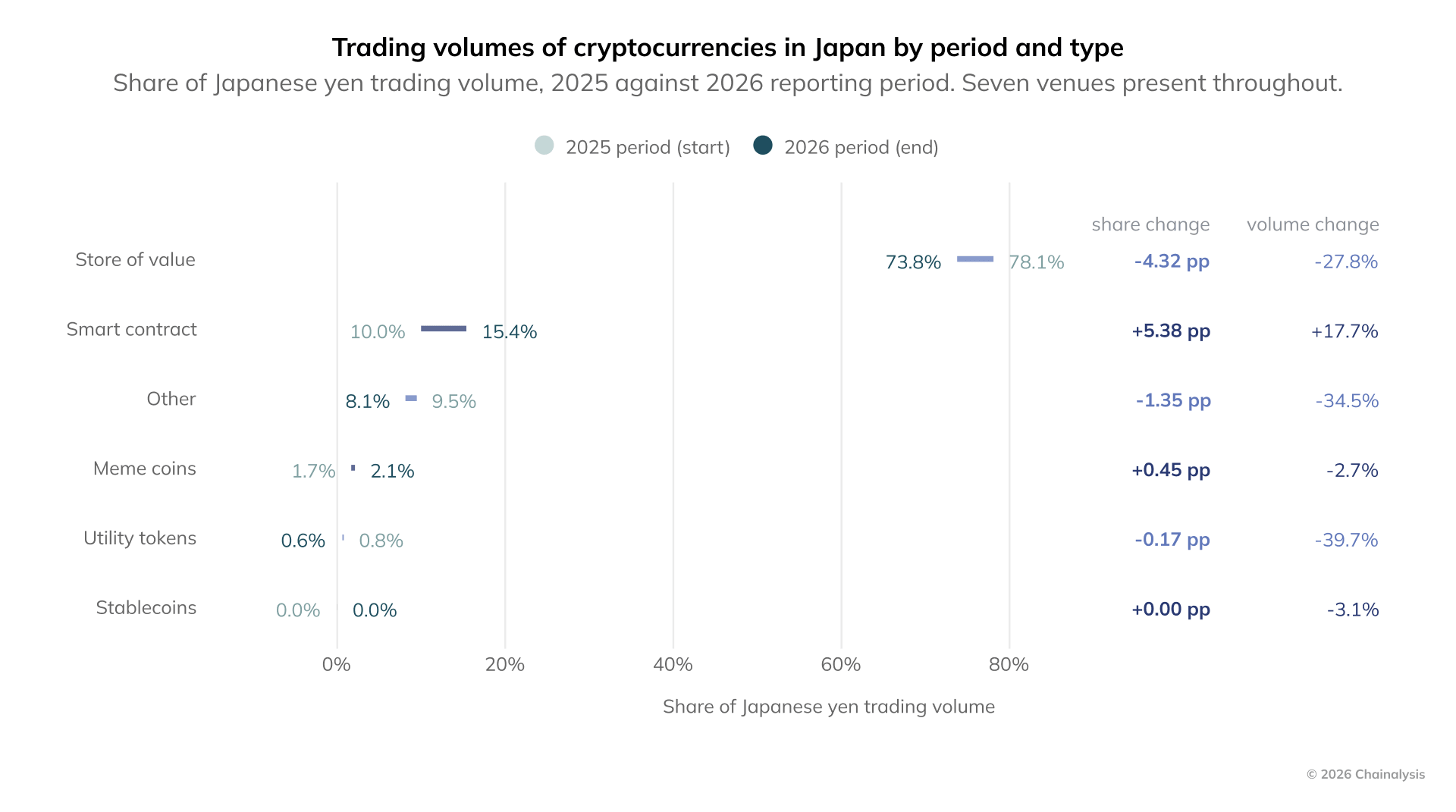
Trading volumes of crypto in Japan by type. Source: Chainalysis
- Bitcoin and other store-of-value assets still dominated yen trading, accounting for 73.8% of volume.
- But their share fell 4.32 percentage points as overall volume in the category dropped 27%.
Smart contract tokens, including Ethereum and Solana, moved in the opposite direction. Their share of yen trading climbed from roughly 10% in the previous period to 15.4%, while absolute trading volume rose 17.7%.
It was the only yen-denominated token category tracked by Chainalysis to grow in absolute terms.
Taxes have long limited how far that activity can expand. Japanese crypto gains faced marginal rates as high as 55% during the period covered by the report, compared with the separate taxation used for many traditional investments.
Reforms advanced in July could eventually bring eligible crypto gains closer to a roughly 20% separate tax rate, a change local industry participants expect could bring more traders into the market.