


Tokenized real-world assets, also known as RWAs, grew nearly 180% over the past year to more than $33.8 billion, bringing government debt, private credit and other traditional investments onto blockchains. But the market is hardly a retail revolution.
- Arrakis, an on-chain market maker, traced more than 71,600 buyers and $91.3 billion in gross purchases across 10 tokenized dollar-yield products, using Ethena's sUSDe as an additional benchmark.
- It found that only 2,586 wallets, or about 4% of buyers, made purchases worth at least $1 million, yet they accounted for roughly 93% of all capital.
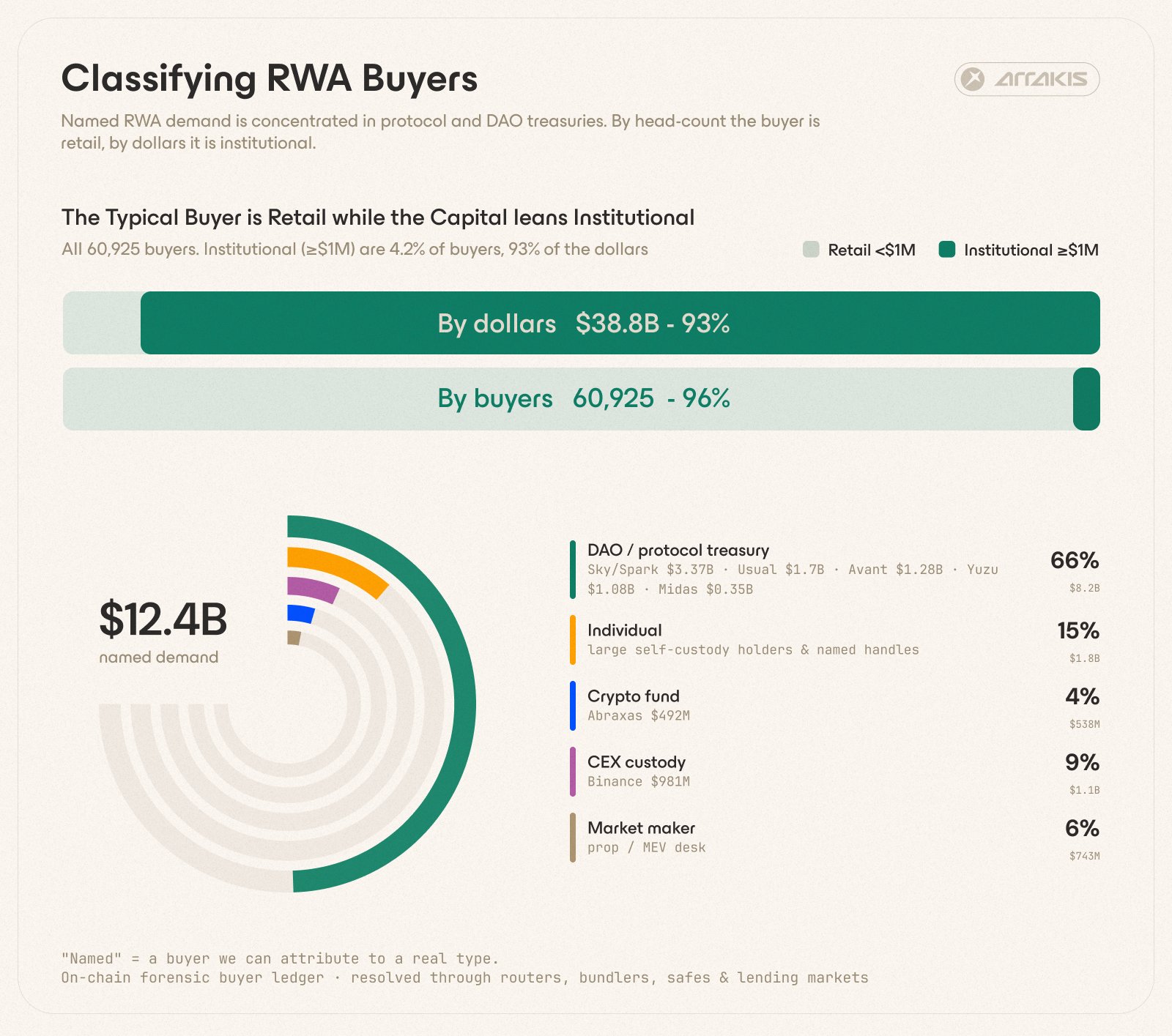
Chart showing RWA buyers by category. Source: Arrakis
Retail investors mostly padded the holder counts.
Ondo's USDY, a tokenized yield product backed by short-term U.S. government debt and bank deposits, had one of the clearest splits, where retail wallets represented 95.6% of buyers but held less than 1% of its value.
- Arrakis also found that sUSDe had by far the largest retail presence in its sample.
- It accounted for about 80% of all retail buyer wallets and 73% of retail acquisition value.
- And still, retail represented just around 10% of the product's total acquired value.
The large buyers were mostly crypto-native institutions rather than identifiable Wall Street firms. Of $12.4 billion that Arrakis could classify, two-thirds came from protocol and decentralized organization treasuries.
Dean Khan Dhillon, head of growth at RWA.xyz, a tokenized-asset data platform.
The assets also behave less like freely traded tokens than private financial products placed on a blockchain.
- Between 93% and 100% of purchases were made directly through issuers, while DEXs handled no more than 6% for most products.
- After buying, most holders simply kept the assets to collect their underlying yield, the data shows.