
Everyone wants stablecoins regulated, except nobody agrees why
The stablecoin story is getting weird as the same product looks like a dollar boost, a Europe problem, a bank threat and a Japan opportunity.

Central bankers can't agree if stablecoins are the future or a detour. Over the past few days, policymakers in the U.S., Europe, the UK and Japan all talked about the same thing, but from completely different angles.
- Federal Reserve Governor Christopher Waller, for instance, sees stablecoins as a dollar amplifier.
- Bank of England policymaker Megan Greene thinks they may fade.
- European Central Bank officials warn they could cement dollar dominance.
- Japan's ruling party wants yen stablecoins to compete in Asia.
Same market, completely different endings.
Waller, a Fed governor who has repeatedly taken a more open view on stablecoins, said at an event in Dubrovnik, Croatia, that dollar stablecoins could broaden the reach of U.S. monetary policy, Bloomberg reported on May 31. "Countries that adopt it, it's like a fixed exchange rate system," Waller said.
That is the pro-dollar case for stablecoins. If people outside the U.S. start using dollar tokens for payments, savings or settlement, the dollar gets another global rail. It also means the Fed's decisions could travel further, because dollar stablecoin users outside the U.S. would still be tied to dollar rates.
Waller also pushed back against the idea that stablecoins are some kind of built-in threat.
"I've always just looked at stablecoins as a payment instrument; there's nothing evil about it, nothing dangerous about it," Waller said, according to a Reuters report. "They are just bringing competition into the payments world."
No stablecoin talks by 2031
But Megan Greene, a Bank of England policymaker, had almost the opposite read on the same panel.
She said stablecoins may lose the race to tokenized deposits, digital versions of regular bank deposits, that could give users blockchain-style settlement without moving money outside the banking system.
"I think tokenised deposits are probably going to take over from stablecoins and five years from now, I suspect we might wonder why we were talking about stablecoins," Greene said.
Greene argues that stablecoins scare banks because they can pull deposits away. But once banks realize that money may leave anyway, they could build their own blockchain-based deposits and claw back the payment layer.
Contagion risks
Europe is looking at the same race but with a way more defensive lens. Isabel Schnabel, an ECB Executive Board member, said in a June 1 speech that stablecoins can bring payment benefits, but they can also create risks for banks.
The concern is that stablecoins are overwhelmingly dollar-based. If they spread into global payments, the dollar could become even harder to dislodge, not because the U.S. economy suddenly became stronger, but because payment networks are sticky, she argued.
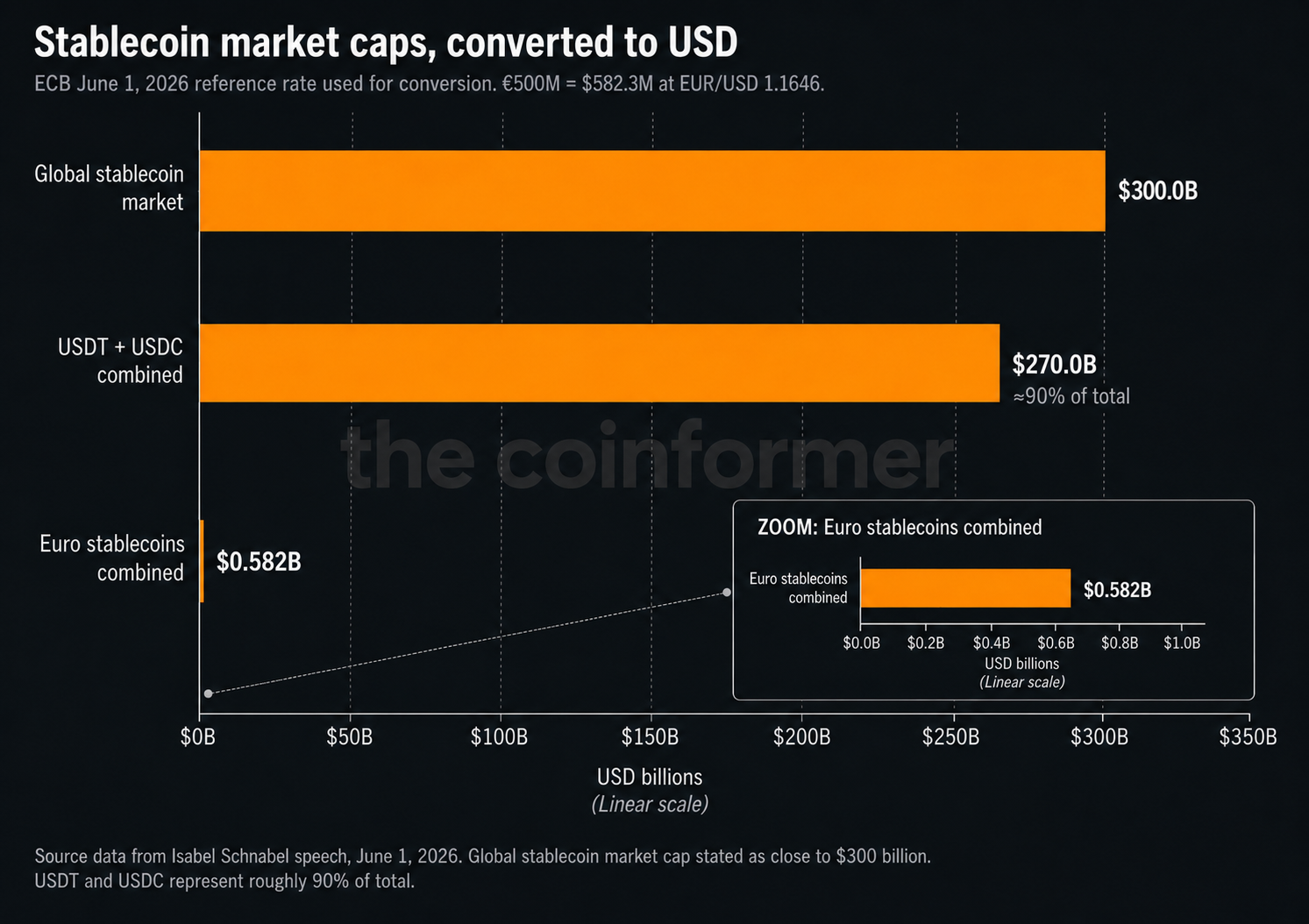
Stablecoin market cap chart showing USDT and USDC dominate at about $270 billion, while euro stablecoins total about $582 million. Source: The Coinformer
Schnabel said global dollar stablecoins could create new cross-border networks where dollarization becomes "a byproduct of the adoption of the new technology."
- Schnabel said global stablecoin market capitalization is now close to $300 billion, while Tether's USDT and Circle's USDC account for roughly 90% of the total.
- Euro stablecoins, by contrast, remain tiny, with about €500 million (around $580.7 million) in combined market cap, she said.
And that appears to be Europe's nightmare scenario. The euro could miss the next payment rail while dollar tokens become the default money of tokenized finance.
So the ECB is now trying to keep public money in the game through a digital euro for consumers and tokenized central bank money for wholesale markets.
More context: ECB rejects softer rules for euro stablecoins as too risky
Now or never
Japan is taking a different route. A ruling Liberal Democratic Party panel told the government it should promote yen stablecoins for settlement in Asia, Reuters reported on June 1. The same proposal also called for a legal framework for crypto exchange-traded funds.
Junichi Kanda, a lawmaker in the panel, said Japan urged the government to support yen stablecoins for Asian settlement.
Having started as a payments revolution, stablecoins are now starting to look like a geopolitical fight.
If dollar tokens become the default rails for global settlement, the U.S. could get another way to extend its currency power, while Europe, Japan and others may have to decide whether to build their own alternatives or risk seeing the next payment layer settle around someone else's money.
Read also: Japan tests blockchain payments between banks
Discuss this article:


Community Notes
Explain what is inaccurate or missing and cite original, reliable sources. Your browser creates a private signing key so one persistent contributor—not cookies—builds a track record.
Rate independently. Live totals are hidden while consensus forms, and one network can contribute only one eligible rating to a note.
The stablecoin story is getting weird as the same product looks like a dollar boost, a Europe problem, a bank threat and a Japan opportunity.