

Bridge co-founder Zach Abrams is launching a new crypto venture backed by some of the biggest names in payments, finance and tech, raising the temperature in an already crowded stablecoin market and putting fresh pressure on Circle.
In a blog announcement on Tuesday, June 30, Abrams unveiled Open Standard, a new stablecoin company that plans to issue Open USD, a dollar-backed stablecoin built around a consortium of more than 140 companies across payments, banking, crypto and technology.
The partner list is unusually broad. It includes Visa, Mastercard, American Express, Stripe, BlackRock, BNY, Google, Cloudflare, Shopify, DoorDash, Fireblocks, Solana, Polygon, Ripple, Gemini, and, surprisingly, Coinbase, among many others.
- Coinbase and Circle helped build USDC together through Centre, the consortium that originally governed the stablecoin.
- When Centre was dissolved in 2023, Circle brought USDC governance in-house, while Coinbase took an equity stake in Circle and kept a major economic relationship around USDC reserve income.
- Although Coinbase remains economically tied to USDC, it's also now backing a rival stablecoin network whose pitch appears designed to weaken one of the most profitable parts of Circle's business.
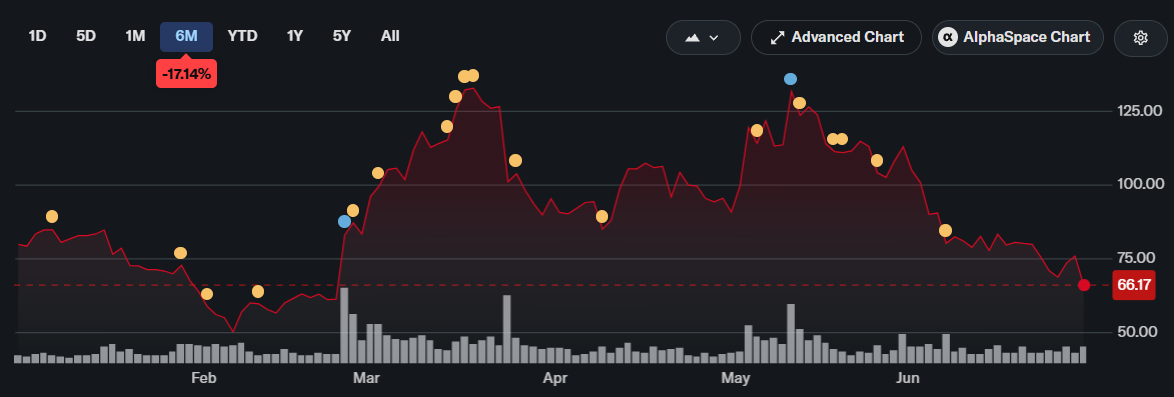
CRCL stock price. Source: Yahoo Finance
And investors seemed to treat the announcement that way. Circle shares recently fell more than 13% to $66.05, near February levels, after the Open Standard news, according to Yahoo Finance data.
Shortly after the news broke, Circle CEO Jeremy Allaire appeared to weigh in on X, though he didn't name Open USD or refer to it directly.
Jeremy Allaire
Tether CEO Paolo Ardoino was more direct, welcoming OUSD and writing in an X post that "Player 2 has entered the game," implicitly treating Tether and Open Standard as the only two players in the stablecoin race.
Targeting duopoly
Open Standard hasn't yet proved whether the model can work at scale, but its pitch is already clear and pretty aggressive toward rivals. Per the announcement, businesses "can mint and redeem Open USD at no cost and with no artificial limits on volume."
Circle and Tether earn major revenue from reserves backing USDC and USDT, while businesses that distribute or use those tokens usually don't get the same economics.
Tether charges 0.1% to acquire USDT and the greater of $1,000 or 0.1% to redeem, with a $100,000 minimum transaction size, according to its fee structure on its website.
Circle's customers can mint for free and use basic redemptions for free, while near-instant standard redemptions carry fees of 0.03% above $2 million, 0.06% above $5 million and 0.1% above $15 million, per a regulatory filing.
Open Standard is also pitching governance as part of the product. The company says it will have a board made up of Open USD partners, rather than being controlled by a single issuer.
- Open USD is expected to go live later this year and launch natively on multiple blockchains, including Solana, Stellar, Base, Plasma, Tempo and Polygon.
Omar Kanji, a partner at crypto VC firm Dragonfly Capital, suggested in an X post that a Coinbase-Circle "break-up" looks "imminent," arguing that Coinbase is joining a tech and traditional finance stablecoin consortium while Circle is launching Arc, its own blockchain that could compete with Coinbase's payments business, products and Base.
Omar Kanji
Still, the unusually large partner list needs some caution. Open Standard says "businesses across industries have signed up to use Open USD," but the announcement doesn't clearly define what "signed up" means for each participant.
It also remains unclear whether all named companies have formal partnership agreements with Open USD, committed integrations, or a looser role in the proposed network.