


Bitcoin price may not have found its cycle bottom yet, with Galaxy Research pointing to a base-case range of $40,000 to $46,000 sometime between now and Q4 2026.
Galaxy Research, the research arm of Mike Novogratz's crypto firm Galaxy Digital, said in a June 12 report by Alex Thorn, Galaxy's head of firmwide research, that Bitcoin's 4-year cycle still appears to be alive, even as each boom and crash is getting smaller.
The report's core argument is that Bitcoin's October 2025 peak was unusually calm. Bitcoin hit an all-time high of around $124,820 on Oct. 6, 2025, but the usual signs of retail mania were mostly missing.
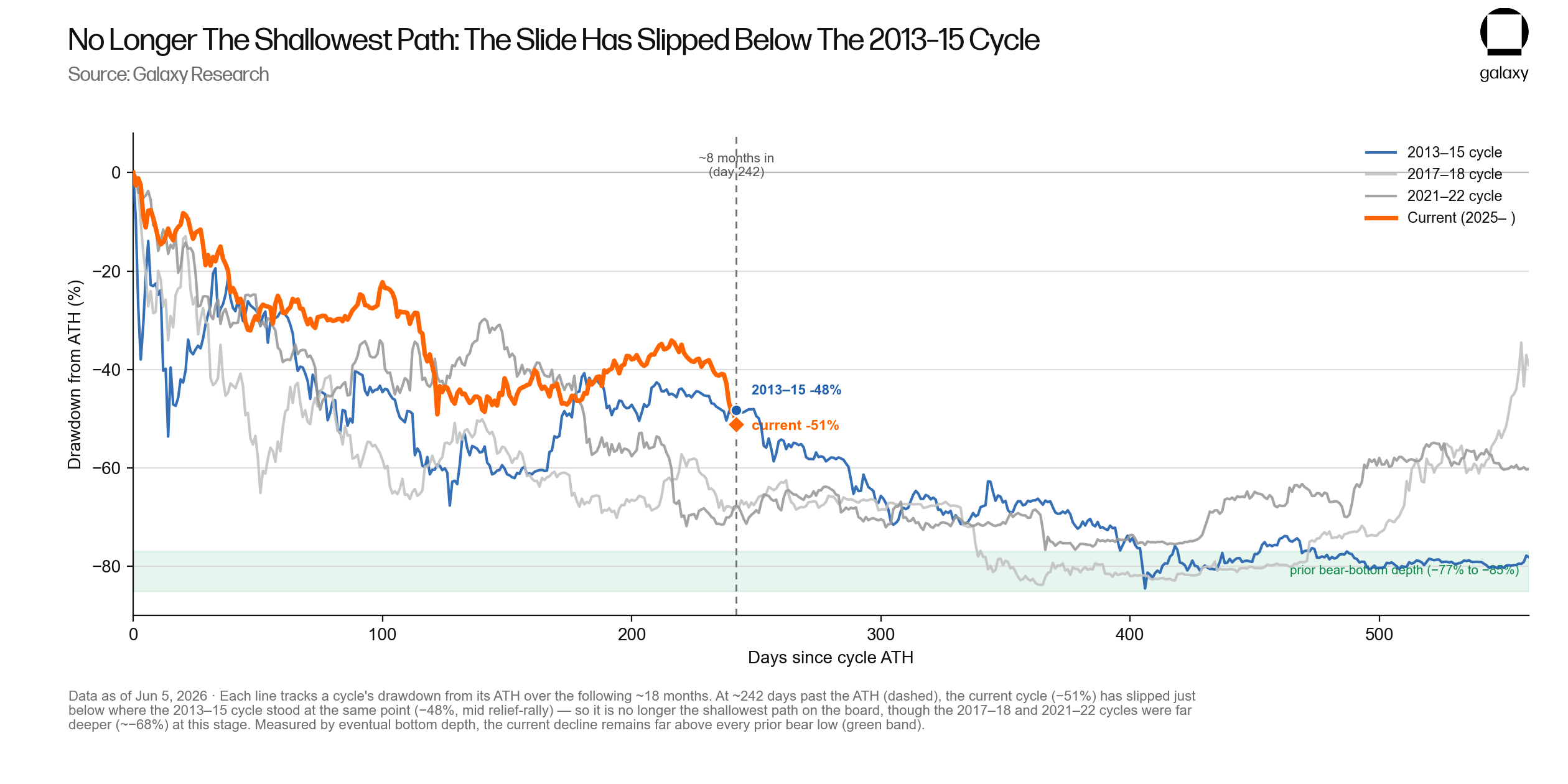
Chart comparing Bitcoin cycles. Source: Galaxy Research
Galaxy Research notes that only two of 11 classic top-warning signals appeared during the cycle, and even those barely cleared prior thresholds.
- Bitcoin's MVRV ratio, a measure comparing market value with the average holder cost basis, peaked at 2.29 this cycle, compared with 2.93 in 2021, 4.72 in 2017 and 5.91 in 2013.
That calmer top left the market's cost basis much closer to the peak, the firm argues, noting that Bitcoin's cost basis sat at about 43.7% of the prior all-time high, compared with 34.2% in 2021, 21.2% in 2017 and 16.9% in 2013.
Galaxy Research
Read also: Ethereum treasury Sharplink teams up with Galaxy to back DeFi
Why the old crash rule may be broken
The usual bear-market shortcut says Bitcoin falls 75% to 85% from its high. This time, Galaxy Research claims that the rule may be too harsh because it ignores how much calmer the top was.
A 77% to 85% fall from the October high would imply a bottom around $19,000 to $29,000.
But Galaxy argues that applying that old rule now may double-count the pain because the peak itself was already much closer to Bitcoin's realized price, an on-chain estimate of the average price holders paid for their BTC.
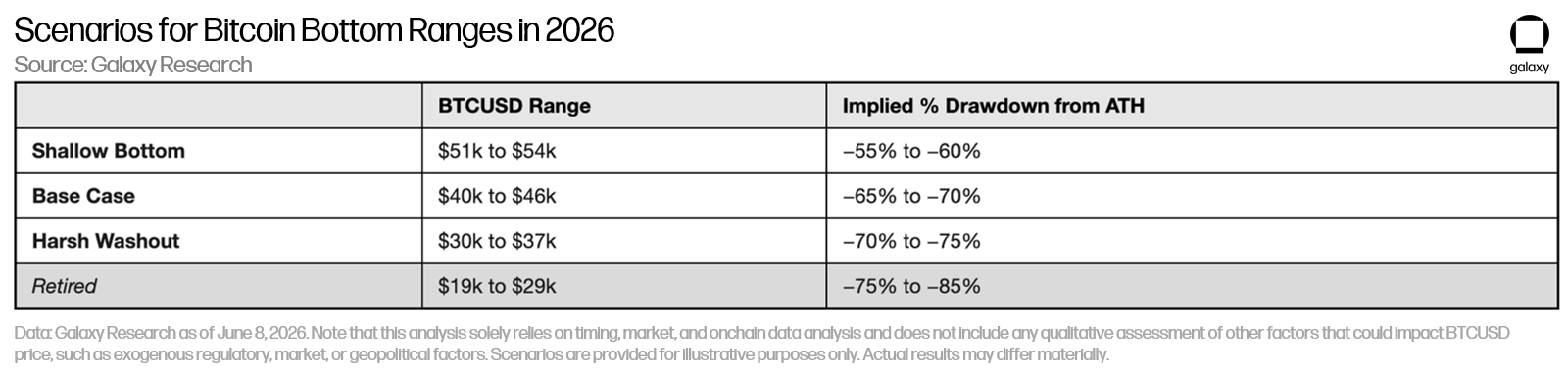
Table showing Bitcoin price forecasts for 2026. Source: Galaxy Research
Instead, the firm's base case puts the bottom near $40,000 to $46,000 if the cycle keeps compressing toward fair value. A harsher washout could land around $30,000 to $37,000, while a shallower bottom near cost basis could sit around $51,000 to $54,000.
The bottom signals are not there yet
The report still says the bottom is likely not in. Only four of 13 historical bottom indicators have flashed so far, while seven have not.
Galaxy Research
Galaxy Research points out that the stronger signals that marked previous bear-market bottoms haven't appeared. Those include Bitcoin trading below its realized price, holders sitting on aggregate losses and sustained loss-taking across the market.
- So far, Bitcoin is down about 51% from its October high, far less than the 77% to 85% drawdowns that ended prior cycles.
- It's also only about eight months past the peak, while previous cycle bottoms arrived roughly 12 to 13 months after the top.
More context: Galaxy gets New York BitLicense for institutional crypto services